Mountain Pass · San Bernardino County, California
Rare earth claims near the Mountain Pass Mine
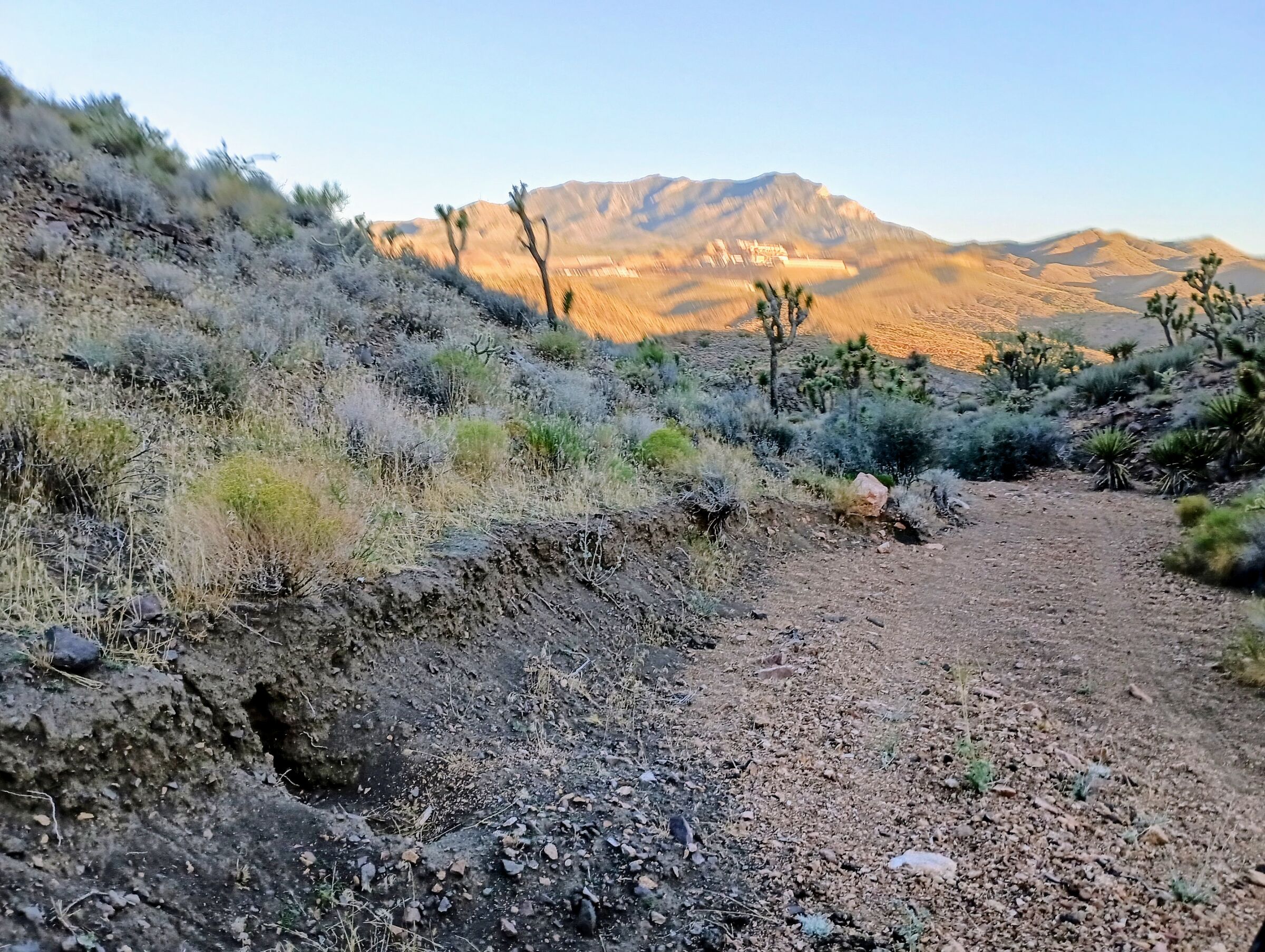
Mountain Pass Rare Earths, LLC holds rare earth lode claims at Mountain Pass, California, southeast of MP Materials’ Mountain Pass Mine. The claims are genetically related to that deposit. Both come from the same original group of claims staked by P.A. “Pop” Simon in 1949, and are owned by his son and grandchildren.
Claims
26
Unpatented lode claims and mill site on BLM land
Earliest location
1925
Helper, Grey Eagle, Horn Toad, Avalanche
BLM status
Fees paid
Maintenance fees for the 2026–27 assessment year, paid Aug. 24, 2026
Mountain Pass · San Bernardino County, California
Rare earth claims near the Mountain Pass Mine
Mountain Pass Rare Earths, LLC holds rare earth lode claims at Mountain Pass, California, southeast of MP Materials’ Mountain Pass Mine. The claims are genetically related to that deposit. Both come from the same original group of claims staked by P.A. “Pop” Simon in 1949.
Claims
26
Unpatented lode claims and mill site on BLM land
Earliest location
1925
Helper, Grey Eagle, Horn Toad, Avalanche
BLM status
Fees paid
Maintenance fees for the 2026–27 assessment year, paid Aug. 24, 2026
Claim locator
MPRE claims relative to MP Materials
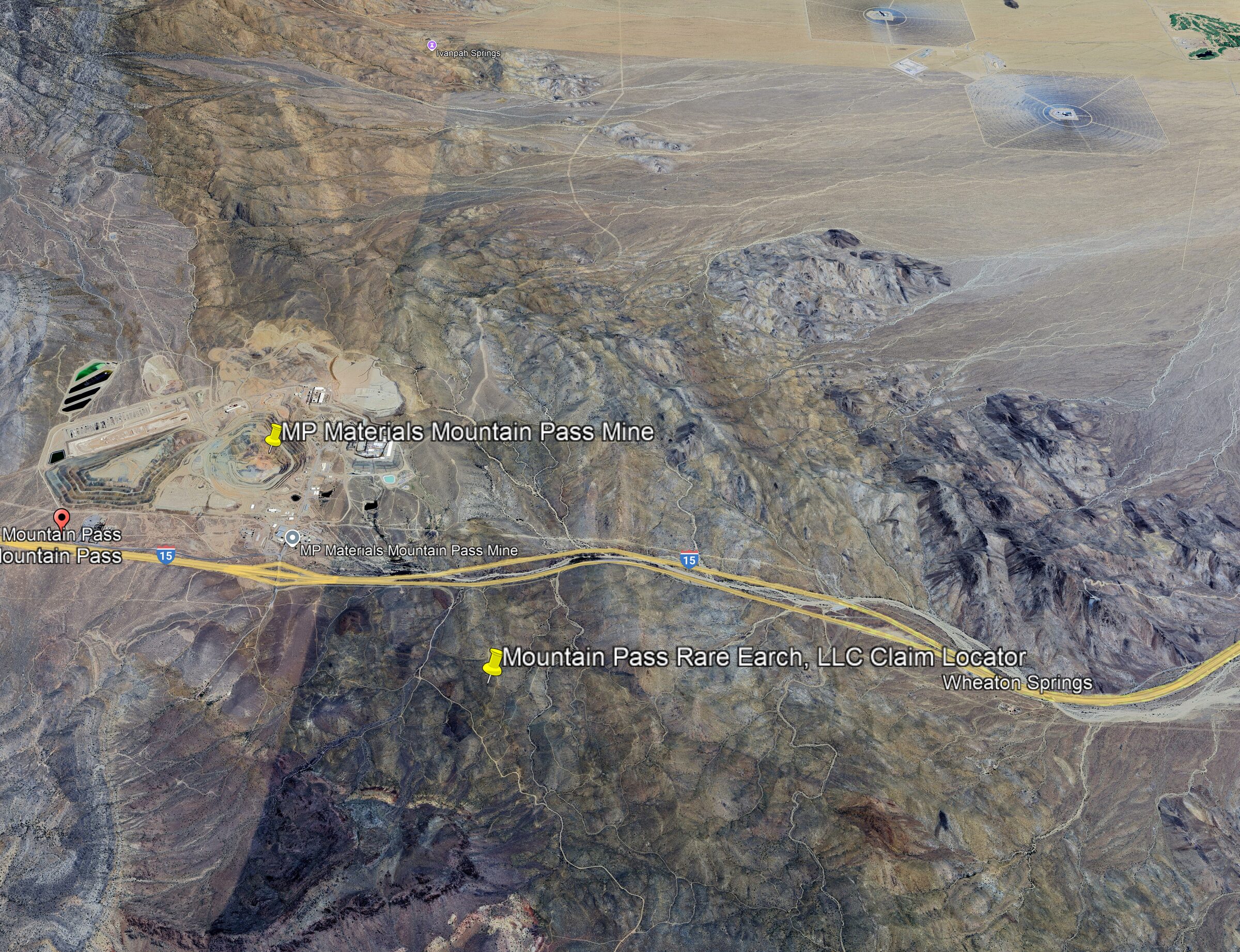
Mountain Pass Rare Earths, LLC claim group, southeast of the MP Materials Mountain Pass Mine, off Interstate 15. Click the image to enlarge. Imagery © 2025 Airbus.
Executive summary
Part of the original Mountain Pass discovery
The Mountain Pass rare earth district was discovered in 1949 by prospectors searching for uranium. P.A. “Pop” Simon was one of them. The claims Mountain Pass Rare Earths holds today are the ones he kept.
Today the claims are held by Pop Simon’s grandchildren.
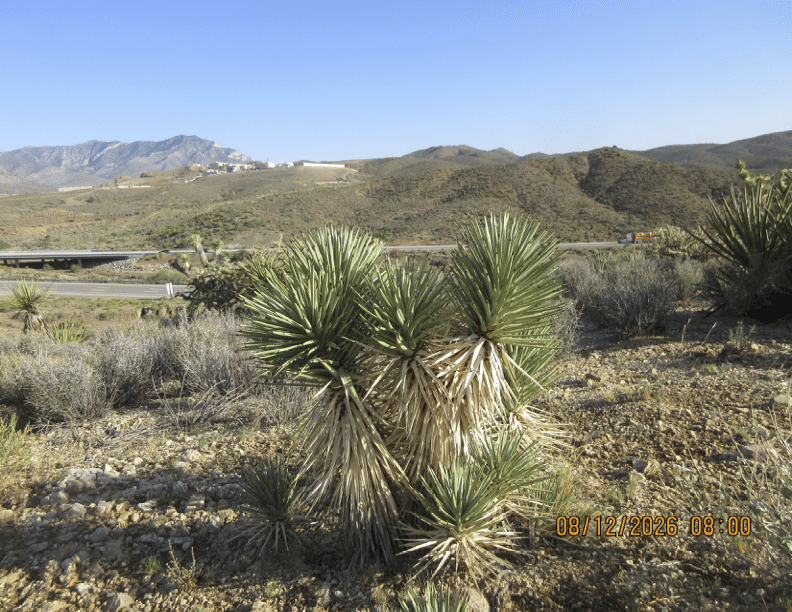
The MP Materials mine from the NW end of the MP Rare Earth claims. Photo taken Aug. 12, 2026.
Same original claim group
The MPRE claims were part of an original group that included the ground now owned and mined by MP Materials.
Located by P.A. “Pop” Simon
On April 23, 1949, Simon and his partners Herbert S. Woodward and Clarence Watkins staked the Birthday claim, the first rare earth discovery at Mountain Pass. Read the story.
The Birthday claims were sold. These were kept.
In February 1950 the partnership sold the Birthday claims to Molybdenum Corporation of America (Molycorp), whose property became the Mountain Pass Mine. Simon kept the claims that make up MPRE today.
Genetically connected
Both sets of claims belong to the same rare earth mineral system. In a 1985 settlement, Molycorp acknowledged the Simon claims as the senior claims over its overlapping “Syenite” claims.
Sampled and independently evaluated
Consulting economic geologist Tom P. Anderson completed extensive surface sampling. Ken Santini of Santini & Associates completed a geologic field evaluation in July 2026.
Claim boundaries · 2012 Partial Record of Survey
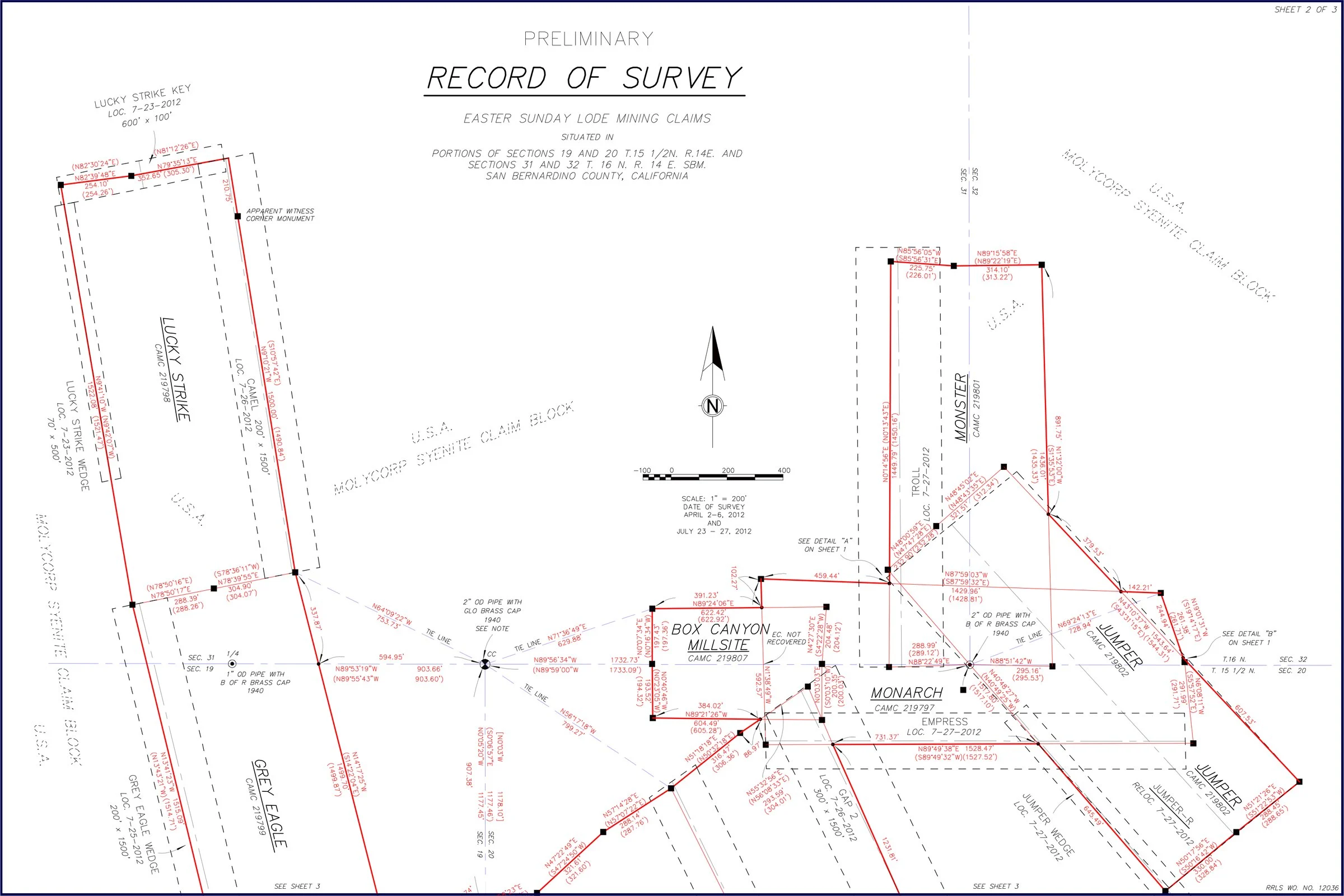
Surveyed claim boundaries
Preliminary
Partial Record of Survey (sheet 2 of 3). Claim boundaries surveyed April and July 2012 by James A. Lapuzza, U.S. Mineral Surveyor (LS 4813). Scale 1″ = 200′.
History · 1949
The Birthday claim
In late March 1949, an engineer named Marty Hess came to the schoolhouse in Goodsprings, Nevada, to talk about prospecting for uranium. The country was hunting for it. Hess mentioned that uranium often turns up with cobalt, and cobalt was common in the old Goodsprings mines.
Herbert S. Woodward, a local engineer, was in the room. Afterward he talked with the miners about searching the cobalt ground with a Geiger counter. P.A. “Pop” Simon, who ran a service station and motor court at Jean, eight miles down the road, offered to buy the counter in exchange for a share of the venture.
For two weeks Woodward tested mine dumps and old prospects. Nothing registered, and he was ready to quit. Fred Piehl, a local prospector, suggested one last try: the rock specimens stored at his cabin, collected across southern Nevada and nearby California. The lead and gold ore from Sulphide Queen Hill, near Mountain Pass, set the counter off.
Piehl already held the Sulphide Queen ground, so the partners searched the hills to the northwest. Clarence Watkins of Goodsprings joined Simon and Woodward as a third partner.
On April 23, 1949, about 4,000 feet northwest of the Sulphide Queen shaft, the counter showed intense radioactivity along a vein outcrop. It was Woodward’s birthday, so they named the claim the Birthday. A shallow pit exposed six feet of vein packed with a heavy, light-brown mineral none of them recognized. They sent a sample to the U.S. Bureau of Mines station at Boulder City. The answer came back: bastnaesite, a mineral rich in rare earth oxides.
They had gone looking for uranium and found one of the world’s great rare earth deposits. Through May and June the partners traced more veins and staked more claims. On July 15, USGS geologist D.F. Hewett walked the ground with Simon, Woodward and Watkins. In November the Secretary of the Interior announced the discovery, and prospectors with Geiger counters poured into the district.
In February 1950 the partners sold the Birthday claims to the Molybdenum Corporation of America. That property became the Mountain Pass Mine, and from 1965 to 1995 it supplied most of the world’s rare earths. Pop Simon kept the claims he believed were more valuable. Those are the claims Mountain Pass Rare Earths holds today.
“Even at that time, it seemed that considerable bastnaesite with some thorium-bearing minerals must be present in the local area.”
D.F. Hewett, on his July 1949 visit with the partners. Foreword to USGS Professional Paper 261 (1954)
Timeline
- Mar 1949Uranium talk at the Goodsprings schoolhouse. Simon buys the Geiger counter.
- Apr 23, 1949Birthday claim staked. The mineral is identified as bastnaesite.
- Jul 15, 1949USGS geologist D.F. Hewett visits the discovery with the three partners.
- Nov 18, 1949Secretary of the Interior announces the discovery.
- Feb 1950Birthday claims sold to Molycorp. Simon keeps his other claims.
- 1952Molycorp begins rare earth production at Mountain Pass.
- 1954USGS Professional Paper 261 credits Simon, Woodward and Watkins with the first discovery.
- 1965–1995Mountain Pass supplies most of the world’s rare earths.
- 1985Molycorp acknowledges the Simon claims as senior to its overlapping claims.
- TodayThe claims are held by Pop Simon’s grandchildren.
Claim register
The original Simon claims
| Claim | Originally located | Sections (SBM) |
|---|---|---|
| Helper | 1925-01-12 | Sec. 20, T15½N, R14E |
| Grey Eagle | 1925-01-20 | Sec. 19, T15½N, R14E |
| Horn Toad | 1925-01-20 | Secs. 19–20, T15½N, R14E |
| Avalanche | 1925-02-08 | Secs. 19–20, T15½N, R14E |
| Lucky Strike | 1945-03-20 | Sec. 31, T16N, R14E |
| Apex | 1951-07-25 | Sec. 20, T15½N, R14E |
| Box Canyon Mill Site | 1952-07-02 | Sec. 20, T15½N · Sec. 31, T16N |
| Monarch | 1952-07-20 | Sec. 20, T15½N · Sec. 31, T16N |
| Monster | 1952-07-20 | Sec. 31, T16N, R14E |
| Jumper | 1967-01-30 | Sec. 20, T15½N · Secs. 31–32, T16N |
| Gap | 1967-01-30 | Sec. 20, T15½N, R14E |
Geology & reports
Independent geologic work
Mineral appraisal · April 25, 1969
C.P. Keegel, Mining & Metallurgical Engineer
Report on the Easter Sunday Group rare earth deposit (Helper, Avalanche, Grey Eagle, Lucky Strike, Apex, Monster, Monarch and Horn Toad claims). Covers history, geology and sample values up to 13.6% R.E.O., and concludes the claims “offer an excellent development possibility.” Includes a claim plan.
Mineral resource evaluation · 2011
Tom P. Anderson, Consulting Economic Geologist
Extensive surface sampling of the claim group, with land status, historical background and a claim register. Excerpts are available on this site. The complete report is available on request.
Geologic evaluation · July 15, 2026
Ken Santini, Santini & Associates
Field examination of rock types, faults, carbonatite veins and past exploration trenches on the original ten lode claims. Based on the USGS Professional Paper 261 geologic map, with a review of earlier studies.
Geologic connection
The Sulfide Queen orebody
The Sulfide Queen Orebody at MP Materials’ Mountain Pass Mine is one of the world’s most significant rare earth deposits. Its southern part trends south-southeast, toward the Simon lode claims.
Along its trend
~2,740 ft
Wide at the surface
~750 ft
Thick
200–300 ft
Depth
~3,000 ft
It is a carbonatite intrusion shaped like a sheet. Its main ore mineral is bastnaesite, a rare earth fluorocarbonate. Mapping and drilling by MP Materials and earlier operators have identified six types of carbonatite ore, and breccia with a carbonatite matrix is common at both the north and south ends.
The same geology continues onto the Simon claims
The same host rock
USGS mapping shows a large body of shonkinite-syenite rock next to the Sulfide Queen Orebody, on its northeast side. The same rock type is exposed at the surface on the west side of the Simon claim block.
Carbonatite veinlets at the surface
On the Simon claims, that rock is cut by many carbonatite veinlets. Carbonatite is the rock that holds the ore at Mountain Pass.
A controlling fault
A major fault, the Middle Fault, runs through the MP Materials open pit. It continues next to the shonkinite-syenite body on the Simon claims, on its southwest side.
Why it matters. The Simon claims share the Sulfide Queen’s host rock, fault structure and carbonatite veining. These are strong geologic signs that a buried carbonatite body may lie within the Simon claims.
Next steps
Defining the ore body
01
Ground survey
02
Aerial survey
03
Exploration drilling
04
Project geologist
05
Sample preparation and storage
06
Analytical test work
Rare Earths 101
Why these minerals matter
What they are
Rare earth elements are a group of 17 metals: the 15 lanthanides plus scandium and yttrium. What is rare is not the elements themselves but a deposit concentrated enough to mine at a profit.
What they power
Neodymium and related elements go into the permanent magnets used in electric vehicle motors and wind turbine generators. Rare earths also appear in defense systems, jet engines, medical imaging and everyday electronics.
Why domestic supply matters
Mountain Pass is the only operating rare earth mine in the United States. Rebuilding mining, separation, refining and magnet making at home is now a stated federal priority.
Federal investment in the domestic supply chain
Announced, executed or conditionally committed
~$1.27B
Direct federal capital across five programs. Commitments at different stages, not money fully disbursed.
Most conservative subtotal
$604.0M
Source: Federal Investment in the Domestic Rare Earth Supply Chain, Appendix F, updated Sept. 23, 2026.
Contact
Discuss the claims with the owners
Qualified parties can ask for the full Anderson and Santini reports, claim documentation and site access. Send a short note and the owners will reply directly.